
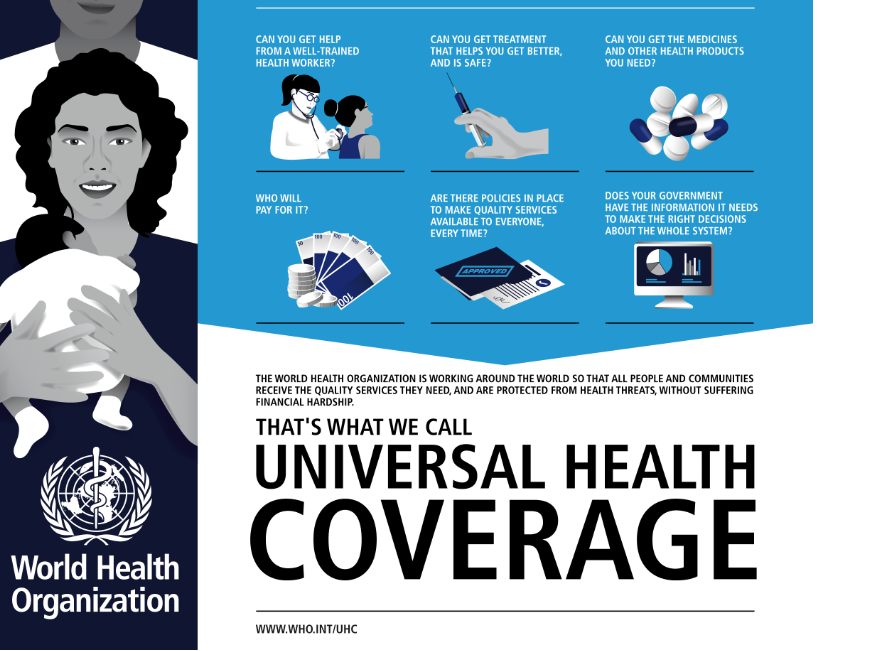
Namibia’s ambition to achieve Universal Health Coverage (UHC) marks one of the most important and potentially transformative public policy reforms since independence. Yet while the goal of ensuring that all Namibians have access to quality healthcare without suffering financial hardship is widely supported, the road towards UHC raises difficult questions about financing, governance and equity. As the IPPR’s latest Quarterly Economic Review (QER) argues, the country’s current health system remains deeply unequal and fragmented, despite relatively high levels of public spending on health.
At present, Namibia effectively operates three parallel health systems. The majority of the population relies on the public health system funded through the national budget and administered by the Ministry of Health and Social Services. Public servants are covered by the Public Service Employees Medical Aid Scheme (PSEMAS), which gives them access to largely private healthcare services supported heavily by taxpayers. A third group consists of those able to afford private medical insurance through medical aid funds (MAFs).
The disparities between these systems are stark. General public healthcare spending amounts to around N$3 971 per person annually. By contrast, PSEMAS receives a subsidy equivalent to roughly N$26 819 per member, while those using private medical aid contribute an average of more than N$56 000 annually towards their healthcare. These differences inevitably translate into unequal access to services, facilities, medicines and specialist care.
Challenges Persist
At the same time, Namibia already spends a relatively large share of public resources on health. Over the past decade, health expenditure has consistently accounted for between 10% and 12% of total government spending and is expected to rise to 12.6% in FY2026/27. Yet despite this level of expenditure, major challenges persist. A 2019 World Bank Public Expenditure Review concluded that Namibia’s health system suffers from significant inefficiencies and inequalities, while access remains uneven and the health workforce inadequate to meet growing demands.
Against this backdrop, the government’s renewed push towards UHC under President Netumbo Nandi-Ndaitwah represents an attempt to fundamentally reshape health financing and service delivery. The proposed Universal Health Coverage Bill envisages the creation of an Essential Health Services Package (EHSP) available to all Namibians regardless of ability to pay, alongside a National Health Equity Fund (NHEF) that would pool resources from various financing mechanisms.
The reforms could potentially reduce some of the stark inequities currently embedded within the system. They also reflect growing recognition that health policy cannot continue to operate through fragmented financing arrangements that privilege some groups over others. The decision announced in 2025 requiring senior public officials to use public healthcare facilities from April 2026 may also signal an effort to align the interests of policymakers more closely with the realities facing ordinary citizens.
Difficult Choices
However, major uncertainties remain. The most important question concerns financing. Expanding quality healthcare access to the entire population will require substantial additional resources. It remains unclear whether members of private medical aid funds will eventually be required to contribute to the new National Health Equity Fund or how the future relationship between PSEMAS, private medical schemes and the NHEF will operate in practice.
Ultimately, achieving UHC is not simply a technical or legislative exercise. It requires difficult political choices about redistribution, public sector efficiency, corruption risks, service quality and the balance between public and private provision. Namibia’s ambition to provide more equitable healthcare is laudable and necessary. But unless financing realities, governance weaknesses and implementation capacity are addressed openly and transparently, the gap between aspiration and delivery could remain substantial. The debate over UHC therefore deserves sustained public attention, not least because the outcome will affect every Namibian household.